

DRR Consultancy: Delivering Structured And Sustainable Solutions For Complex Demolition Projects
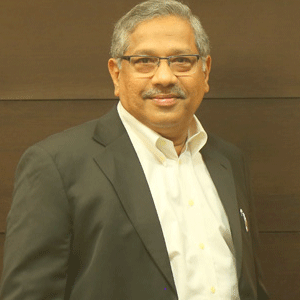
Mohan Ramanathan , Director
India’s industrial demolition and dismantling landscape is undergoing a decisive transition. Much of India’s infrastructure, built 40–50 years ago, is nearing the end of its useful life, while regulations, environmental responsibilities, and safety standards are becoming stricter. Power plants, refineries, factories, bridges, and old public-sector assets are being increasingly shut down to make room for the new infrastructure. This movement has resulted in a tricky market in which demolition is not an activity based on the contractor alone anymore but is subject to systemized risk management, mechanization, sustainability planning, and adherence to arising national codes.
Addressing these challenges is DRR Consultancy, a specialist demolition, recycling, and remediation consultancy practice led by Mohan Ramanathan, one of India’s most experienced professionals in the field. The concept of DRR, which translates to Demolition, Recycling, Remediation, and Consultancy, demonstrates how the whole process is carried out during assignments. Working as an independent consultant, but not a traditional firm, Ramanathan has almost 50 years of industry experience and has a proven track record of executing some of the largest and technically sophisticated demolition projects in the country. His consultancy is founded on the idea that demolition needs to be planned, engineered, and executed with as much rigour as construction.
Strategic Demolition Expertise
The consultancy has a unique position in the market where committed demolition consultants are virtually absent. Since India is carrying out the mass dismantling of power plants, industrial facilities, and other infrastructure constructed in the 1970s and 1980s, customers are turning to outside expertise to determine risk, use the right demolition methodologies, and align the execution with safety and sustainability objectives. “We support asset owners and EPC players by conducting comprehensive feasibility studies, risk assessments, and method evaluations long before demolition begins, ensuring decisions are technically sound rather than cost-driven shortcuts,” says Mohan Ramanathan, Director of DRR Consultancy.
Site inspections, critical-stage reviews, and continuous risk mitigation ensure that demolition proceeds in a controlled, predictable manner, even when legacy structures present undocumented or hazardous conditions. DRR Consultancy has the main role of teaching clients about their legal obligations as owners of assets. This involves the responsible disposal planning, maximum materials recovery, and incorporation of recycling pathways meeting the national guidelines. Dangerous substances like asbestos, as well as polluted structural elements are detected early, and their disposal plans are consistent with the small, yet growing ecosystem of expert handling agencies in the nation.
Sustainable Demolition Practices
The consultancy makes active efforts to encourage selective demolition, on-site recycling whenever possible, and circular utilization of recovered materials to minimize transportation, emissions and dependency on landfills. Remediation that is frequently ignored in India is a critical advisory aspect, which deals with soil and ground pollution that remains as a by-product of historical industrial action and promotes land restoration, which permits further safe exploitation. Mechanized and robotic demolition, precision dismantling, and controlled explosive demolition are recommended where appropriate, with a strong emphasis on client education.
Looking ahead, DRR Consultancy sees strong growth driven by India’s infrastructure renewal cycle, rising sustainability expectations, and demand for safer demolition practices. Alongside active consultancy work, Ramanathan is committed to knowledge dissemination through mentoring, academic engagement, and an upcoming book to help build India’s next generation of demolition and recycling professionals and establish demolition consultancy as a recognized discipline in its own right.
🍪 Do you like Cookies?
We use cookies to ensure you get the best experience on our website. Read more...