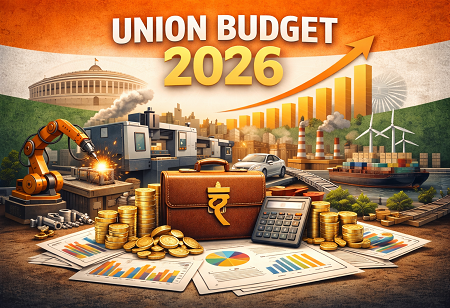
Union Budget 2026-27 Focuses on Seven Strategic Sectors
- Budget 2026-27 focuses on boosting seven key sectors, biopharma, semiconductors, electronics, chemicals, capital goods, textiles, and sports equipment
- Programs include Biopharma SHAKTI, ISM 2.0, expanded electronics and container schemes, Rare Earth Corridors, Hi-Tech Tool Rooms, and Chemical Parks
- Integrated schemes for textiles, handicrafts, Mega Textile Parks
The Union Budget 2026-27 shows that the government wants to increase manufacturing activities in seven key trading sectors which will help India achieve its goal of becoming a worldwide manufacturing center.
The project aims to develop manufacturing facilities which will decrease the need for imported goods while establishing value chains that can compete with international standards. Finance Minister Nirmala Sitharaman explained that these programs operate within Budget priority areas which the government designates as its "First Kartavya" framework.
Biopharma SHAKTI serves as the main feature which provides ₹10,000 crore over five years to establish India as a worldwide biopharmaceutical manufacturing center.
The initiative plans to increase domestic production of biologics and biosimilars through three new NIPER institutes seven existing institutes and more than 1000 authorized clinical trial locations. The CDSCO will acquire more regulatory capabilities through the establishment of a specialized scientific review team.
Also Read: Union Budget 2026: Govt Slashes Duties to Boost Manufacturing
The announcement of ISM 2.0 extends support to semiconductor equipment and material manufacturing through its implementation of the India Semiconductor Mission. The expansion of the Electronics Components Manufacturing Scheme to ₹40,000 crore provides financial support to the electronics sector.
The Budget introduces Rare Earth Corridors as a strategy to assist mineral-rich states by establishing pathways for the extraction and processing and production of rare earth magnets.
The establishment of New Chemical Parks, Hi-Tech Tool Rooms and construction equipment manufacturing facilities and the ₹10,000 crore Container Manufacturing Scheme create stronger industrial capabilities for the country.
The integrated programme for textiles focuses on five areas which include fibres and employment and sustainability and skilling and the establishment of mega textile parks. The country plans to create jobs and develop new ideas and strengthen its global manufacturing network through its support of khadi, handicrafts, sports goods production and rural business development.