
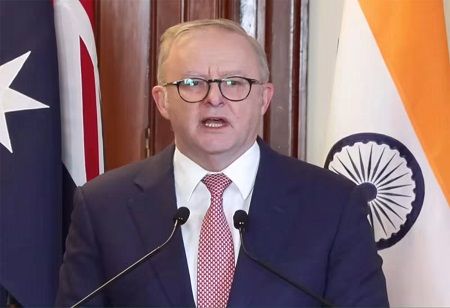
Australia Finalises Uranium Export Deal with India: Albanese
Synopsis: Australia has finalised an agreement to begin uranium exports to India for peaceful civilian nuclear energy, strengthening strategic ties, supporting clean energy goals, and reinforcing long-term cooperation under the bilateral civil nuclear framework.
Australia has finalised an agreement to kick off uranium exports to India for peaceful, civilian nuclear energy uses, which is sort of a big milestone in the strategic partnership between the two nations. Australian Prime Minister Anthony Albanese said it today, noting the announcement shows the increasing trust and collaboration between Canberra and New Delhi, and it also backs India’s widening clean energy goals. This step also reinforces joint work in the energy arena, and it underscores both countries’ resolve toward sustainable economic progress and energy security.
The uranium exports will be done under the present India–Australia Civil Nuclear Cooperation Agreement; it basically allows Australian uranium to be supplied exclusively for peaceful, civilian purposes. The deal also has tight safeguards in it, to make sure the nuclear material is used only in places that run under international monitoring, and that everything lines up with the International Atomic Energy Agency, (IAEA) guidelines, plus the non-proliferation commitments.
Australia actually has some of the world’s biggest uranium reserves, while India is trying to lock in dependable fuel sources so it can keep expanding its nuclear power programme. This partnership is seen as a way to give India a steadier and more varied flow of uranium , basically so the country can grow electricity generation using low-carbon nuclear energy as it moves toward its longer-term climate goals and net-zero emission targets.
Prime Minister Albanese said the deal is, uh, another major move for shoring up the Comprehensive Strategic Partnership between India and Australia. He pointed out that the two countries have actually ramped up collaboration a lot in the past few years, across a range of areas like commerce, critical minerals, defence, technology, schooling, and clean energy. The uranium export arrangement kind of takes that a step further too because it brings in a crucial angle for bilateral energy security, so it broadens the relationship in a more practical way.
In India, nuclear power ends up being sort of an integral piece in its broader strategy to diversify the energy mix, while also reducing reliance on fossil fuels. The country has already laid out pretty ambitious plans, to ramp up its nuclear energy capacity during the next decades, in order to handle the rising electricity demand and help industrial growth along. Access to uranium from abroad is expected to be steadier, which should make fuel more available for the reactors that are already running, and at the same time make it easier to start up future nuclear power projects.
Also read: PM Modi Backs Two-State Solution for Israel-Palestine Peace
The agreement also helps deepen this wider cooperation between India and Australia in the clean energy arena. Both countries are working side by side on renewable energy technologies, hydrogen work, critical minerals, battery supply chains, and various decarbonisation efforts. And by bringing nuclear power into their energy partnership, the two nations are trying to back a kind of steady transition towards cleaner yet more dependable energy systems, for everyone involved.
Industry experts tend to think that when uranium exports finally start, it could help India in the long run with energy security, mostly because fuel sources get more variety and some supply risks fade. Steady uranium deliveries are seen as really important if the country wants nuclear reactors to keep running without interruption, those reactors in turn deliver dependable base load electricity, but with no direct carbon emissions. For that reason nuclear power is often treated as a key piece of India’s approach to reaching sustainable economic progress, even if the details are a bit more complicated than they sound.
Beyond the energy cooperation angle, this deal sort of highlights how India and Australia are, more or less, aligning strategically in the Indo-Pacific space. Both nations have steadily pushed engagement through senior political talks, defence cooperation, maritime safety initiatives and then also via multilateral forums like the Quad, which is pretty telling. The partnership seems to be getting stronger, driven by similar concerns about maintaining regional stability, building resilient supply chains, and keeping sustainable economic growth on track.
The uranium export agreement is expected to bring long-term perks for both countries, sort of a win as they say. Australia gets entry into one of the world’s most rapidly expanding energy markets, while India ends up with another dependable supply of nuclear fuel, to back up its growing clean energy build-out. And beyond that, the whole deal kind of signals rising confidence in India strong non-proliferation track record, plus its careful attitude toward civilian nuclear power.
With the agreement now finalised, Australia and India are set to boost their energy partnership to a new level. The start of uranium exports doesn’t just bolster bilateral economic and strategic ties but also backs India in moving toward cleaner energy. In the same time it reinforces regional cooperation and it helps drive wider global efforts for sustainable, and low-carbon economic development too.