India, Canada Ink $1.9bn Landmark Uranium Supply Deal MoU
- India and Canada signed an MoU on critical minerals and a long-term uranium supply deal with Cameco Corp. to support India’s nuclear expansion
- The agreement expands collaboration in clean energy, hydrogen, solar, and energy storage, with a Renewable Energy and Storage Summit planned
- Both nations will deepen ties in AI, quantum computing, semiconductors, and space, and aim to double bilateral trade by 2030 through a new economic partnership
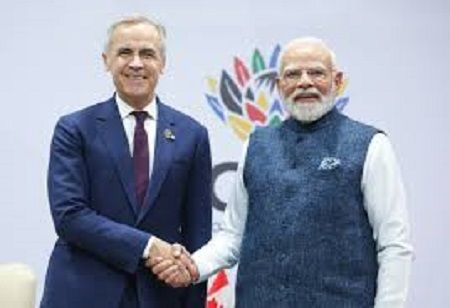
The Indian and Canadian governments established a comprehensive Memorandum of Understanding on critical minerals, which they signed on to recently, while they established a permanent uranium supply contract during Prime Minister Mark Carney's initial visit to India.
The agreements which Prime Minister Narendra Modi witnessed in New Delhi establish a significant expansion of bilateral ties between the two countries, which include energy and technological exchange and advanced research activities.
A C$2.6 billion agreement establishes a partnership between Cameco Corp. and India, which will result in 22 million pounds of uranium delivery between 2027 and 2035. The agreement enables India to increase its nuclear power capacity from 8.8 GW to 100 GW by 2047 because India needs more nuclear fuel resources than its domestic uranium supplies.
Canada maintains its position as the second-largest uranium producer in the world, which enables it to provide essential support for sustaining long-term nuclear fuel supplies.
Also Read: India-Kazakhstan Renew Uranium Supply Pact Agreement Soon
The two countries signed an MoU which focuses on critical minerals to create sustainable supply chains, which will support clean energy technologies, electric vehicles and advanced manufacturing.
The two countries established further collaboration for liquefied natural gas, solar power, hydrogen and energy storage technologies, which will include an India-Canada Renewable Energy and Storage Summit later this year.
Canada announced its decision to join both the International Solar Alliance and the Global Biofuel Alliance. The two countries established a partnership which extends beyond energy to include artificial intelligence, quantum computing, semiconductor and space research.
The agreements show that the two parties have resumed their strategic relationship while they work to finalize a Comprehensive Economic Partnership Agreement, which targets a trade expansion to double by 2030.