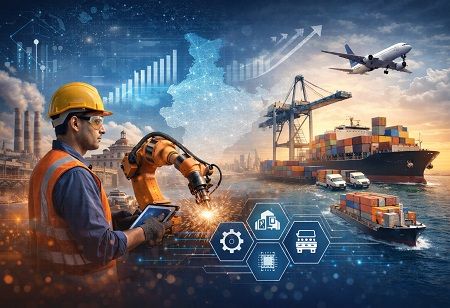
How Policy, Technology and Exports are Redefining Indian Manufacturing
Indian manufacturing is no longer competing on cost alone it is competing on capability. Factory floors are being redesigned, supply chains re-engineered, and production decisions shaped increasingly by global demand rather than domestic convenience. With the global value chains restructuring, India is emerging as a reliable manufacturing partner in the world. This change represents a transition towards value-based production which gets propelled by more taut policy regimes, more intensive use of technology and a more export-led orientation which focuses on quality, reliability and future competitiveness.
Policy as an Enabler of Industrial Scale and Discipline
The Indian manufacturing policy has shifted away from intent-based initiatives towards results-based initiatives. With programmes like Make in India, scale, better localisation, and performance rewards have come into focus instead of focusing on capacity per se. The combination of sector-specific incentives, investments in infrastructure, and simplified compliance systems is all lessening the friction among manufacturers that seek to compete against others on an international scale.
The PLI framework has fundamentally changed investment behaviour by linking incentives directly to output, quality benchmarks, and export performance. This has prompted businesses to look ahead, invest in supply-chain depth, process efficiencies, and technology rather than rest on short-term cost advantage.
“PLI schemes have witnessed exports surpassing Rs 4 lakh crore with significant contributions from sectors such as electronics, pharmaceuticals, and food processing,” Jitin Prasada, Minister of State for Commerce and Industry, Government of India.
Technology and the Rise of Capability-Driven Manufacturing
Technology no longer plays the support role in Indian factories, but is now taking centre stage in competitiveness. Implementation of automation, data analytics, and interconnected systems related to Industry 4.0 is assisting manufacturers in enhancing their productivity, minimal errors, and increasing the reliability of their delivery. The digital tools are facilitating real-time decision-making on the shop floor using automotive components, pharmaceuticals, and electronics.
It is also changing the dynamics of the workforce. This is shifting away to process control, maintenance analytics, and optimization of systems. Although automation lowers the need for repetitive labour, it raises the requirement of skilled technicians, engineers, and digital specialists that skilling and reskilling is vital to ensuring the continuity of growth.
“The vision of making India a manufacturing and export powerhouse started many years ago as a way to reduce the dependence on imports and change India’s status to that of a global manufacturer capable of manufacturing in-house and supplying to the rest of the world,” says Rajesh Parameswaran, Executive Director & Industrial Sector Leader at IBM Consulting.
Exports and India’s Deeper Integration into Global Value Chains
Exports have emerged as a defining force in India’s manufacturing evolution. Global supply chains are undergoing realignment due to geopolitical shifts, risk diversification strategies, and the search for dependable production partners. India is increasingly positioned as a viable alternative, particularly in electronics, automotive components, specialty chemicals, and engineering goods.
What sets the current phase apart is the emphasis on value addition. Indian manufacturers are moving from supplying basic intermediates to producing finished systems and regulated products that meet international standards. Export requirements are influencing factory design, supplier selection, ESG compliance, and quality governance from the outset.
“The next phase of India’s manufacturing success depends on how effectively we plug ourselves into global value chains. It is not enough to produce more; we must produce what the world needs, at the quality and reliability that global markets demand,” says V. Anantha Nageswaran, Chief Economic Advisor to the Government of India.
Indian manufacturing establishes its new international position because export orientation, together with technological depth and policy alignment, work together to create this transformation. The challenge ahead lies in ensuring that this transformation extends beyond large players to MSMEs, creating a manufacturing ecosystem that is not only competitive but also resilient and inclusive.