.jpg)
Industry Reacts: Budget Sparks Growth in Manufacturing & Tech
Industry leaders have welcomed the Union Budget with cautious optimism, highlighting the government’s commitment to driving growth in the manufacturing and industrial sectors. With key allocations for infrastructure development, technology adoption, and production-linked incentives (PLIs), the budget promises to accelerate the country’s transformation into a global manufacturing hub. The emphasis on sustainable practices and reducing logistical costs also aligns with the industry's push for a more competitive edge. For manufacturers, this budget brings renewed hope for scaling operations, enhancing productivity, and attracting foreign investment.
Paritosh Ladhani, Joint Managing Director of SLMG Beverages
 “The Union Budget 2026 strongly reinforces a manufacturing-first, ‘Make in India’ approach, which is encouraging for companies that are deeply invested in domestic production and local supply chains. The continued push on infrastructure, with capital expenditure raised to ₹12.2 lakh crore, will directly benefit beverage manufacturers by improving logistics efficiency, distribution reach, and last-mile connectivity across markets. The focus on localisation across bottling, packaging and allied inputs supports greater cost stability and resilience, while sustained support for MSMEs remains critical given their integral role in our vendor and transport ecosystem.
Although there were no direct tax incentives for non-alcoholic beverages, the broader pro-manufacturing and pro-consumption policy environment, along with ongoing discussions on GST rationalisation, provides a positive foundation for volume-led growth and long-term expansion of India’s packaged beverage sector."
Niranjan Nayak, MD, Delta Electronics India
 What stand out in Union Budget 2026 is the scale, consistency, and seriousness with which the government is approaching electronics and advanced manufacturing. The launch of India Semiconductor Mission 2.0 with an outlay of ₹40,000 crore, along with the expansion of the electronics components manufacturing scheme to a similar level, clearly signals a long-term commitment to building strong domestic capabilities.
Importantly, the focus goes beyond manufacturing capacity to include full-stack design, development of Indian intellectual property, skill creation, and stronger supply-chain resilience. This reflects a practical understanding of how globally competitive technology ecosystems are built. Such clarity and continuity in policy direction give industry the confidence to plan long-term investments, deepen local value addition, and steadily move India up the electronics manufacturing value chain.
Manish Agarwal, Managing Director, Satya Group, President, CREDAI Haryana
 In the lead-up to Union Budget 2026, the real estate sector was looking for a combination of demand-side support, tax incentives, and reforms to ease project delivery and financing. While a few of these did not receive immediate focus, the Budget’s clear commitment to reform anchored in an infrastructure-led growth strategy, emphasis on Tier-1 and Tier-2 markets, and a reforms-over-rhetoric approach offers a strong foundation for sustainable sector growth.
At the same time, the industry continues to look forward to sharper policy support for affordable housing, particularly through rationalized transaction costs, improved access to finance, and measures that enhance viability for developers while preserving affordability for end users. Strengthening affordable housing remains critical for maintaining broad-based demand and urban inclusivity.
The proposal to monetize and recycle CPSE-owned real estate reflects a pragmatic reform mindset by addressing the long-standing scarcity of well-located urban land. When aligned with investments in future-ready infrastructure and connectivity, these measures can ease supply constraints, encourage planned densification, and attract institutional capital. Over time, this can enable more balanced, efficient, and economically productive urban development across India, while positioning emerging cities as sustainable engines of real estate demand.”
Nitin Jain, Joint Managing Director, Concord Control Systems Limited
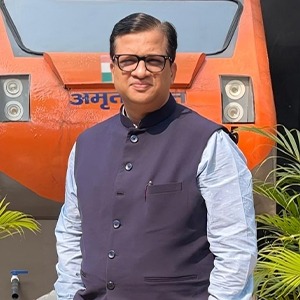 The Union Budget FY27 presents a decisive and forward-looking vision for India’s transport and infrastructure ecosystem, anchored by a record ₹17.14 lakh crore effective capital outlay. This scale of investment firmly positions railways at the heart of India’s long-term mobility and logistics strategy driving high-speed connectivity, strengthening freight corridors, and enabling a more integrated, efficient movement of people and goods across the country.
The Budget’s continued emphasis on indigenisation, advanced electronics, and technology-led infrastructure signals a maturing industrial landscape where innovation and resilience will be key differentiators. For Concord Control Systems, this is a defining moment. As India accelerates towards intelligent, autonomous, and digitally enabled rail networks, we remain deeply committed to strengthening the control, signalling, and embedded electronics backbone that will power the next generation of rail modernisation. We are proud to play an active role in shaping a future-ready railway ecosystem for a rapidly growing India.