India Joins US and 13 Economies on Global Excess Capacity
India joins the US and 13 other economies in a joint effort to address structural excess capacity, market distortions and non-market policies across key manufacturing sectors.
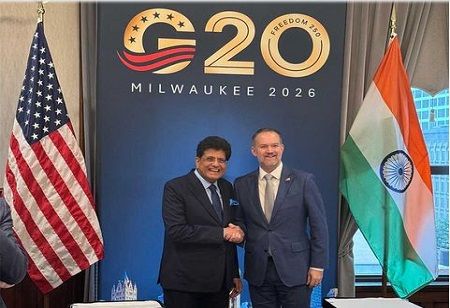
India has joined the United States and 13 other economies in signing a joint ministerial statement aimed at addressing structural excess capacity and production in key manufacturing sectors. The statement calls for measures to curb non-market policies and practices that distort markets and contribute to persistent production imbalances. It was released by the Office of the United States Trade Representative (USTR) following discussions at the G20 Trade Ministers’ Meeting in Milwaukee.
The 15 participating economies include Argentina, Australia, Canada, the European Union, France, Germany, India, Italy, Japan, South Korea, Mexico, Poland, Turkiye, the United Kingdom and the United States. The economies agreed to cooperate through dedicated sectoral platforms to examine structural excess capacity and develop measures to address its impact on industries, workers and global trade.
Also Read: Solar Manufacturing: Powering India's Vision of Viksit Bharat
The statement identifies automobiles and electric vehicles, batteries, chemicals, foundational semiconductors and solar panels as initial areas of focus. The participating countries said structural excess capacity can lead to overproduction and excessive concentration of manufacturing, affecting prices, investment, competition and market-based production. They also raised concerns that such conditions can increase trading partners’ dependence on particular sources of supply.
The countries called on governments to eliminate policies and practices that distort markets and contribute to structural excess production. They also recognised that individual measures would be more effective when countries cooperate, exchange information and coordinate responses where possible.
Senior officials from the participating economies met on the sidelines of the Organisation for Economic Co-operation and Development (OECD) Trade Committee to begin work under the new sectoral platforms. The countries have committed to meeting at the technical level before December 2026 to develop terms of reference, exchange non-confidential information and data, and identify gaps in understanding structural excess capacity and its effects.
India’s participation follows discussions at the G20 Trade Ministers’ Meeting, where Commerce and Industry Minister Piyush Goyal said industrial capacity itself should not be treated as the problem. He argued that concerns should instead focus on market distortions arising from factors such as hidden subsidies and geographical concentration of production. Goyal also stressed that responses should remain consistent with World Trade Organization rules and should not shift adjustment burdens onto developing economies.
Also Read: What Neo Banks Are and Why People Choose Neo Banks
The joint statement follows the G20 meeting, where ministers did not reach consensus on excess industrial capacity. China, Brazil, Indonesia, Russia, Saudi Arabia and South Africa were among the G20 members that did not sign the new statement.
The participating economies said they would explore effective and, where possible, complementary actions to protect their economies from the negative effects of structural excess capacity while seeking conditions for market-oriented competition to develop across the identified sectors.