
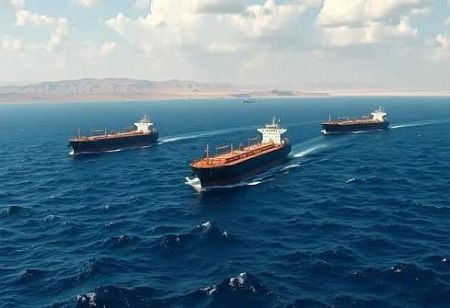
India Seeks Safe Hormuz Passage for Nine Merchant Ships
Synopsis: India is seeking safe passage for nine merchant ships near the Strait of Hormuz as renewed tensions threaten a fragile truce. The government is coordinating with regional stakeholders to safeguard crews and ensure energy security.
India has stepped up diplomatic efforts a bit, to obtain safe passage for nine merchant vessels that are currently placed around the Strait of Hormuz, as fresh hostilities in West Asia threaten a fragile ceasefire, and honestly this situation is quite tense. The Ministry of External Affairs and various other government agencies are now coordinating closely with local partners and regional stakeholders, so that the safety of Indian ships and their crews is protected while the country’s energy supply lines stay secure, even if the geopolitics are still moving fast.
The Strait of Hormuz still counts as one of the world’s most critical sea chokepoints, and it moves a big slice of global crude oil plus liquefied natural gas exports too. If there is any interruption to shipping through that tight passage, then it triggers near immediate effects on energy prices worldwide, freight routing, and overall commerce. Lately, the security environment has been getting worse, so India has started keeping a close eye on vessel travel and, at the same time, talking with partner countries across the region, trying to make sure maritime passage stays uninterrupted, as much as possible.
Per officials, India is trying to get assurances for the safe passing of nine merchant ships that are either waiting for transit, or are currently near the Strait. On the diplomatic front, talks are still in motion with Gulf nations and other important parties, to reduce the risks for Indian vessels and for seafarers. The government seems to be giving top priority to shielding Indian nationals who are working on these ships, while also keeping the flow of essential imports going especially crude oil and petroleum products.
The newest developments arrive with a previously agreed truce in the region looking a bit shaky, after some fresh attacks on commercial vessels, and a run of renewed military exchanges. Things are heating up, and that raises worries on maritime safety, higher insurance costs, tighter shipping schedules, and even global energy supply lines. International shipping firms keep choosing caution while passing through that strategically crucial waterway, because you know, it’s all still pretty unpredictable.
Also read: Afghan Agriculture Minister Ataullah Omari Visits India
India has been maintaining a kind of close back-and-forth communication with governments across the Gulf region, even Iran and also members of the Gulf Cooperation Council, to safeguard its maritime interests. The country’s diplomatic reach has been more like aimed at making sure there is freedom of navigation, for protecting commercial shipping, and for securing steady energy supplies during this period of increased geopolitical uncertainty.
The Indian government has also strengthened coordination, between the Ministry of External Affairs, the Ministry of Shipping, the Directorate General of Shipping and the Indian Navy to monitor how things are developing. The authorities are tracking vessel movements, in real time and they remain ready to respond to any emergency involving Indian ships, or crew persons. Meanwhile existing maritime security mechanisms carry on supporting commercial shipping operating in the area.
The Strait of Hormuz is kind of especially crucial for India, because a large share of the country’s crude oil arrivals comes from Gulf nations. If there is some long-lasting blockage or disruption, it could mess with energy availability, raise transit expenses, and push prices higher inside the country, for domestic fuel. So, in the end, keeping passage through the Strait without interruption is a strategic priority for New Delhi, and it can’t really be treated like routine business.
Despite the heightened tensions, officials have said, in a sort of not too direct way, that diplomatic engagement is still the preferred approach for ensuring safe transit. India keeps pushing for peaceful dialogue and stability across West Asia, meanwhile it works alongside regional partners to shield international shipping routes and keep global trade flows moving, even when things feel a little uncertain.
India’s continued efforts to secure safe passage for its merchant fleet shows how the country, is moving first, when it comes to guarding maritime trade and also energy security in a stretch of geopolitical unease. The government keeps up a close diplomatic dialogue and day to day operational coordination, so it can protect Indian seafarers, keep commerce running without a break, and reduce as much as possible the effect of regional tensions on the nation’s economic priorities.