India US Trade Ties Unsettled by Russia Sanctions Law
India’s Finance Ministry says US trade ties remain unsettled after the Graham Bill became law, allowing tariffs of up to 100% on countries buying Russian crude, amid ongoing trade talks.
India-US trade relations remain unsettled following the passage of the Lindsey O. Graham Sanctioning Russia and Iran Act of 2026, according to the Finance Ministry’s September Monthly Economic Review. The assessment comes as New Delhi and Washington continue negotiations on an interim trade agreement.
The newly enacted law gives the US President powers to impose tariffs of up to 100% on countries that purchase Russian crude oil. The legislation is significant for India because the country continues to import Russian crude as part of its broader energy sourcing strategy. The Finance Ministry said the development adds to the uncertainty surrounding India-US trade relations.
Also Read: How AI Is Reinventing the Future of Manufacturing
The assessment was released on the same day Commerce and Industry Minister Piyush Goyal met US Trade Representative Jamieson Greer on the sidelines of the G20 Trade Ministers’ Meeting in Milwaukee. Goyal said the two sides held discussions aimed at an early conclusion of a mutually beneficial interim agreement under the India-US Bilateral Trade Agreement.
The Finance Ministry also highlighted broader external challenges facing the Indian economy. It said global capital flows are being influenced by the artificial intelligence investment boom, while developed economies are competing to attract investment to support renewed manufacturing activity. Increasing use of supply chains as strategic instruments is adding to the complexity for developing economies seeking foreign capital.
According to the review, India faces a challenging environment for attracting capital flows amid geopolitical and geoeconomic uncertainty. The ministry said net foreign direct investment inflows into India are nevertheless expected to perform better in the current financial year than in the previous year.
The report also pointed to pressure from higher global oil prices and rising bond yields. Higher crude prices can increase India’s import bill and affect inflation and the rupee, while changing global financial conditions can influence capital flows into emerging markets.
Also Read: How Intelligent Battery Sensors Improve EV Battery Accuracy
Despite the external pressures, India’s trade performance remained strong in August. Total exports rose 25.4% year-on-year to $82.7 billion, while imports increased 18.8% to $92.1 billion, narrowing the overall trade deficit to $9.4 billion from $11.6 billion a year earlier.
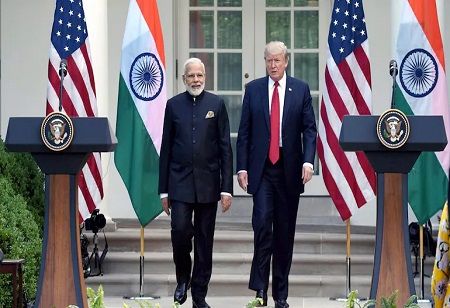
The latest assessment comes amid continuing high-level engagement between India and the US. Prime Minister Narendra Modi and US President Donald Trump also spoke on September 30 about bilateral cooperation, while trade negotiations continue alongside discussions on energy and other areas.