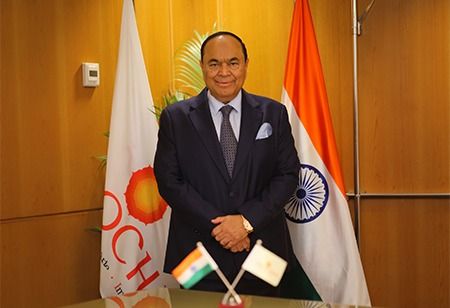

Piyush Goyal Pushes Faster FDI Approvals and Easier KYC
India seeks to accelerate FDI flows by streamlining approvals, improving KYC procedures and exploring regulatory recognition agreements, while strengthening manufacturing, self-reliance and the investment climate through targeted policy reforms.
India plans to bring further ease in its FDI system through improving its approvals process, KYC procedures, and cooperation with regulators outside the country. According to India's Commerce and Industry Minister, Piyush Goyal, there is much room for improvement in making the processes easier and reassuring the foreign investors.
Goyal speaks about this on the occasion of his visit to Osaka, Japan, where he observes that the government's approach to reforming its policies is now moving towards process and procedure reforms instead of reforms of foreign investment policy. This is because only a few sectors have foreign investment restrictions while many others don’t.
Also read: India Gold Discounts Widen as Buyers Await Import Duty Clarity
As per Goyal, quick clearances of investment projects which need clearance from the Department for Promotion of Industry and Internal Trade (DPIIT) or other government bodies can do wonders for the Indian investment climate. Goyal stresses on the fact that quicker procedures would enable firms to take decisions more confidently.
Moreover, the government is also looking into how the KYC procedure can be made quicker and more efficient. As per Goyal, the Indian authorities may look at the option of entering into Mutual Recognition Agreements (MRAs) with regulators of other nations, whereby they will mutually recognize each other’s approvals and avoid duplication of procedures.
According to Goyal, discussions with industry representatives and stakeholders during his Japan visit come up with several suggestions for enhancing the investment framework in India. This process is an ongoing one, where the government consults businesses and investors and takes their suggestions on board for improvement.
In India, 100 percent foreign direct investment is allowed in most sectors through the automatic route, though some sensitive operations still have some restrictions and government approval. There is an attempt by the Indian government to increase the cut-off point for foreign direct investment proposals that require clearance from the Cabinet Committee on Economic Affairs (CCEA), from ₹5,000 crore to ₹15,000 crore.
Another one is that of relaxing regulations on downstream investments, which would give more leeway to foreign money receiving companies and also attract further investments in India.
With India’s attempts to make FDI-related processes more streamlined happening against the backdrop of a robust growth in foreign investments, it should be mentioned that the FDI flows increase by 17% to reach USD 94.5 billion in 2025-2026. Such figures are due to the continuing interest of the foreign investors in the Indian economy.
Goyal further brings to light India’s policy of encouraging manufacturing from end to end and becoming self-reliant in industries that are critical for the nation. It is clear that there is an effort to build complete domestic value chains and not just localize the production process at some particular stage. Semiconductors serve as one example in this regard.
According to the minister, the government will also look into Production Linked Incentives (PLIs) in sectors where the Indian industry has an inherent cost disadvantage vis-a-vis other places. This would be done on a sector-by-sector basis, as a means of improving domestic competitiveness without introducing any distortion.
Also read: The Future of India's Water Infrastructure
India is currently negotiating bilateral trade deals with various nations and regional blocs, such as Israel, Chile, Peru, Canada, the Gulf Cooperation Council, the Eurasian Economic Union, and the Southern African Customs Union. Bilateral and regional trade deals continue to be of primary importance to the government in its attempts to open up markets and integrate India into the world’s value chains.
The combination of speedy clearance, better KYC processes, cooperation between the regulators and incentives is bound to make India a more appealing destination for foreign investors. Through minimizing process hassles and enhancing the local manufacturing base, the government intends to bring more foreign investments to India that will help the country meet its objectives.