Karnataka Unveils Six Initiatives to Boost AI, Chip Sector
Karnataka launches six initiatives in AI, robotics, semiconductor research, healthcare and deeptech at Bengaluru Tech Summit 2026, alongside industry partnerships targeting AI training for 63,200 students and professionals.
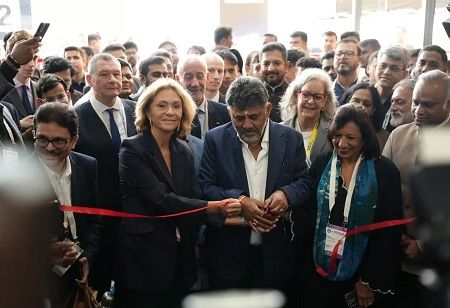
Karnataka has launched six technology initiatives spanning artificial intelligence (AI), robotics, semiconductor research, healthcare technology and deeptech startups to strengthen its position as a global technology hub. Chief Minister D K Shivakumar announced the initiatives at the 29th Bengaluru Tech Summit 2026 on November 17.
The initiatives include the Karnataka AI Hub, Bengaluru Robotics and AI Innovation Zone (BRAINZ), INFIfab, the 2D Innovation Hub, Karnataka Health Engineering and Advanced Lifesciences (K-HEAL) and Innoverse. Together, they aim to strengthen research infrastructure, support technology commercialisation, attract investments and connect startups with academic institutions and industries.
Also Read: Can India Lead the World in Intelligent Machine Manufacturing?
The Karnataka AI Hub, established at IIIT-Bengaluru, will focus on AI research, skilling, innovation and entrepreneurship. It also represents an initial step towards the state's proposed AI University. The government has allocated ₹35 crore for the initiative. A Centre of Excellence at IIIT Raichur is also planned to extend AI applications across 13 districts in North Karnataka, with a focus on agriculture, healthcare, education and small businesses.
BRAINZ, developed in collaboration with ARTPARK at the Indian Institute of Science (IISc), is envisioned as a nine-acre robotics and AI innovation facility. It aims to bring together research institutions, startups and industry players while catalysing investments of ₹1,000 crore over five years.
The semiconductor initiatives include INFIfab, developed with IISc's Centre for Nano Science and Engineering, and the proposed 2D Innovation Hub. INFIfab will feature a 20,000-square-foot cleanroom to support research in semiconductor fabrication, advanced packaging, photonics, quantum technologies and neuromorphic computing. The 2D Innovation Hub will support a national-level 200-mm semiconductor research and development facility with a pilot production line.
K-HEAL will strengthen the healthcare, medical technology and assistive technology ecosystem by connecting clinicians, researchers, companies and startups. Meanwhile, Innoverse will support deeptech ventures working in areas such as autonomous systems, underwater technologies and space applications. Its accelerator programme aims to help 35 growth-stage startups expand over five years.
Alongside these initiatives, Karnataka announced AI skilling partnerships with Google, Salesforce, Pega Systems, Sarvam AI and Gnani.ai. The programmes target 63,200 engineering and diploma students and professionals, covering generative AI, agentic AI, voice AI, cloud computing, data analytics and responsible AI.
Also Read: Why Global Companies are investing more in India's GCCs
Through these initiatives, the state aims to strengthen its technology research capabilities, develop skilled talent and accelerate the transition from innovation to commercial-scale manufacturing and applications.