
India Launches Three Homegrown AI Models Under IndiaAI Mission
India launches EKA-1, Dhīr 2B and Dhīr 5B under the IndiaAI Mission, expanding domestic AI capabilities in multilingual processing, secure deployment and offline applications.
The Government of India has launched three indigenous artificial intelligence (AI) foundation models under the IndiaAI Mission, marking a step towards strengthening the country's domestic AI development capabilities. The models, EKA-1, Dhīr 2B and Dhīr 5B, have been developed by Indian technology companies Soket Labs Technology and Research and ZenteiQ AiTech Innovations, with support from the Ministry of Electronics and Information Technology (MeitY).
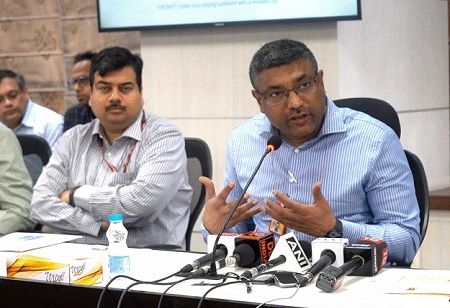
The models were unveiled at an event in New Delhi, in the presence of MeitY Secretary S. Krishnan, senior ministry officials and representatives of the two companies. The initiative is intended to make AI technology more accessible for applications across government, industry, research and education, while supporting specialised requirements involving data security and local language capabilities.
Also Read: Why Global Companies are investing more in India's GCCs
EKA-1, developed by Soket Labs, is an open, sparse hybrid language model featuring 26.3 billion parameters and trained on approximately 7.5 trillion tokens. It supports all 22 scheduled Indian languages alongside English and is designed for mathematics, coding, reasoning and agentic applications. The model is also intended to address specialised requirements in areas such as banking, financial services and cyber security.
ZenteiQ has introduced the other two models, Dhīr 2B and Dhīr 5B, as open-source multilingual AI assistants. They support English and 10 Indian languages and are designed for secure, on-premise deployment. Their capabilities include offline document-based automation, knowledge retrieval and enterprise or citizen-facing services.
Unlike AI systems that depend entirely on cloud connectivity, Dhīr models can operate in low-connectivity environments and sensitive settings. This makes them relevant for sectors such as defence, government, industrial operations and education, where data privacy, secure infrastructure and reliable access to information are important considerations.
Speaking at the launch, Krishnan said the public release of the models represents an important development in building India's AI ecosystem. He highlighted their potential to improve productivity and operational efficiency, particularly through deployment in air-gapped environments. Such capabilities could support organisations that need to run AI applications without connecting their systems to external networks.
Also Read: The Impact Of AI And Machine Learning Technology In Revolutionizing Manufacturing Practices
The models have been developed under the IndiaAI Mission's foundation model initiative, which seeks to encourage the creation of AI systems suited to India's languages, datasets and sector-specific requirements. The mission also supports domestic developers through access to computing infrastructure and research resources.
Through platforms such as AIKosh, the government aims to make these models accessible to researchers, students, innovators and enterprises. The launch adds to India's efforts to develop homegrown AI technologies and expand their use across critical sectors.