Hardeep Puri Meets S&P Chief on Energy Supply Resilience
- India discusses global energy supply chain resilience strategies
- Focus on balancing conventional and clean energy transition
- Talks highlight importance of stable global energy markets
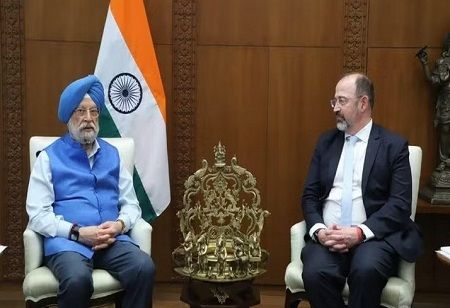
Union Minister for Petroleum and Natural Gas Hardeep Singh Puri held discussions with Dave Ernsberger, President of S&P Global, focusing on global energy markets and the need to strengthen supply chain resilience amid evolving geopolitical and demand dynamics.
The meeting centred on assessing the global demand-supply balance in energy markets and identifying strategies to build more robust and reliable supply chains. Both sides emphasised the importance of stability in energy flows, especially at a time when global disruptions and shifting trade patterns continue to impact pricing and availability.
During the discussions, Puri highlighted India’s dual-track energy strategy, which combines expansion of conventional energy production with accelerated adoption of clean energy solutions. He noted that India is actively advancing initiatives such as green hydrogen development, biofuel blending, and alternative fuels, while also scaling up domestic exploration and production activities to enhance energy security.
Also Read: Rajnath Singh Heads to Kyrgyzstan for SCO Defence Talks
The approach reflects India’s broader objective of creating a resilient and future-ready energy ecosystem, capable of managing both short-term supply shocks and long-term sustainability goals. By balancing fossil fuel requirements with clean energy transitions, India aims to reduce vulnerability to external disruptions while meeting its growing energy demand.
The engagement with S&P Global also underscores the importance of data-driven insights and global market intelligence in shaping energy policy decisions. Institutions like S&P play a critical role in analysing commodity trends, pricing mechanisms, and supply chain risks, which are increasingly relevant for countries navigating complex energy transitions.
Separately, domestic energy supply concerns were also addressed during related discussions. Uttarakhand Chief Minister Pushkar Singh Dhami raised the need for uninterrupted LPG supply during the Char Dham Yatra, highlighting how regional demand spikes and logistical challenges require careful planning and resource allocation.
Overall, the meeting reflects India’s proactive engagement with global stakeholders to ensure energy security while transitioning toward sustainable sources. As global energy systems become more interconnected and volatile, such collaborations are expected to play a key role in maintaining stability and supporting long-term economic growth.