
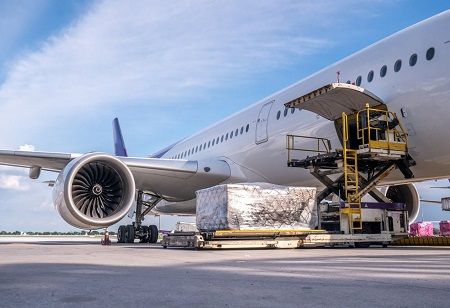
India Expands Air Cargo Transshipment Network to Boost Trade
India is expanding its air cargo transhipment network to reduce transit times, congestion and logistics costs. The latest pilot adds four domestic airports and two international destinations while strengthening cargo security cooperation with 12 countries.
India is expanding its air cargo transhipment network to make cargo movement faster, more efficient and globally competitive. The government has revised the framework for handling and securing transhipment cargo and mail across four movement categories: international-to-international, international-to-domestic, domestic-to-international and domestic-to-domestic.
Under the revised framework, cargo can be processed through dedicated Transfer Cargo Security Hold Areas. Shipments that have already undergone security screening at their origin may be exempted from repeated screening, subject to prescribed safeguards and security-equivalence arrangements with partner countries. The system is intended to reduce duplication while maintaining required security standards.
Also Read: Home Renovation Trends and Material Choices across Urban India
The streamlined process is expected to reduce cargo congestion, dwell time and logistics costs, while allowing security agencies to concentrate their resources on higher-risk consignments. The benefits are already visible on the Chennai-Delhi-Frankfurt route, where transit time has fallen from around 50–60 hours to approximately 20 hours.
The government has now expanded the Proof of Concept to include Bengaluru, Hyderabad, Ahmedabad and Mumbai as domestic origin stations. London and Copenhagen have also been added as international destinations, widening the potential network for businesses handling time-sensitive shipments.
India is simultaneously pursuing security-equivalence arrangements with 12 countries, including the United Kingdom, United States, France, Germany, Japan, the United Arab Emirates and Australia. Such arrangements could facilitate smoother movement of cargo between participating countries by reducing the need for repeated security procedures where equivalent safeguards are recognised.
The expansion comes as India seeks to strengthen its logistics infrastructure and improve the competitiveness of its exporters. Faster air cargo movement can be particularly important for sectors handling electronics, pharmaceuticals, high-value components, perishables and other time-sensitive products.
Also Read: Eco-Friendly Material Engineering to Replace Traditional Plastics
A wider transhipment network could also help Indian airports handle a greater share of regional cargo traffic. Improved connectivity between domestic production centres and international destinations may support more integrated supply chains and reduce dependence on overseas cargo hubs.
For businesses, lower transit times and logistics costs can improve delivery reliability and potentially strengthen India's position in global supply chains. The initiative could also encourage greater use of Indian airports for regional cargo consolidation and distribution.
The expanded pilot therefore represents a step towards developing India as a regional air cargo hub, with streamlined procedures, stronger security cooperation and broader airport connectivity expected to support faster and more competitive international trade.