Jaishankar Urges Inclusive Trade Laws at UNCITRAL Event
External Affairs Minister S. Jaishankar calls for inclusive and future-ready global trade laws at UNCITRAL’s 60th anniversary conference, highlighting the need for transparent legal frameworks that support digital commerce, investment, and sustainable growth.
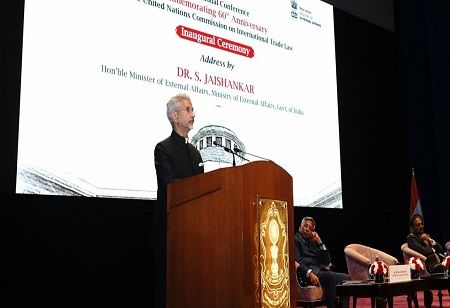
Minister of External Affairs Dr. S. Jaishankar has emphasized the need to create a global legal regime that is more inclusive, transparent, and equitable with respect to international trade at the 60th Anniversary Conference of the United Nations Commission on International Trade Law (UNCITRAL). The conference, being held in India, is attended by policymakers, legal scholars, academicians, and delegates of international organizations, who deliberate on the changing role of international trade law with regard to fostering sustainable economic development, electronic commerce, and foreign investments.
Jaishankar, in his speech, stressed that the legal framework of international trade laws has to adapt to the fast pace of changing technology, economics and geopolitics. As such, the rules regarding the regulation of global commerce have to be flexible and relevant to the requirements of developed and developing countries. In the view of the minister, an equilibrium international legal framework is a must for the equitable distribution of the gains of globalization.
Also read: Flipkart to Enter Food Delivery to Challenge Zomato, Swiggy
It is also important to mention the point that was highlighted by the External Affairs Minister, according to whom modern international trade has become much more integrated due to the development of new technologies, global value chains and cross-border investments. It is essential to mention the importance of legal certainty, predictability and transparency for encouraging the process of international trade. The laws of the modern world must promote innovation and justice.
Jaishankar stressed the need for inclusion of developing countries in the international trading system through the means of inclusive legal systems which will make it easier to participate in the global trading system. According to him, the international commercial laws should reflect various economic and developmental aspects of different states in addition to the promotion of capacity building and exchange of knowledge.
Looking at the evolution of India's economy, Jaishankar underlined the fact that India had been a proponent of regulations, digital public infrastructure, and governance by technology. According to him, India's experience of developing systems of digital payments, e-governance, and digital commerce had shown how innovation could make processes efficient and facilitate the conduct of business. All this, he said, could offer lessons to shape future laws regarding new forms of international business and investments.
Also read: The Future of India's Water Infrastructure
The conference also acts as a forum through which the contributions made by UNCITRAL during its 60 years of existence to the harmonisation of international business laws will be assessed. The contributions of UNCITRAL, since its formation in 1966, have included model laws, conventions and legal instruments designed to enhance international business, commercial arbitration, electronic commerce and dispute resolution. The participants are expected to discuss current issues such as artificial intelligence and digital assets.
The fact that India is hosting such an event points to the increasing role played by India in international economic diplomacy and its interest in building multilateral cooperation. By working towards ensuring that there are future ready trade regulations, India hopes to make its contributions to the international law on trade that encourages innovation and provides equal opportunities in the international economy.