BRICS Adopts Labour Declaration, Launches CONNECT
Synopsis: BRICS Labour and Employment Ministers adopt a joint declaration under India's 2026 Chairship and launch the India-backed BRICS CONNECT platform to strengthen cooperation on social security, skills development, digital labour governance, and labour market reforms across member countries.
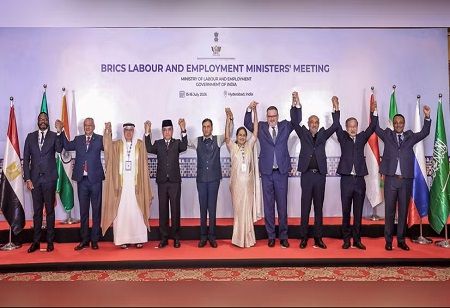
BRICS Labour and Employment Ministers have adopted a joint declaration and launched the India-backed BRICS CONNECT platform during the 12th BRICS Labour and Employment Ministers' Meeting held in Hyderabad under India's 2026 Chairship. The initiatives aim to deepen cooperation among member nations on labour market reforms, social security, workforce development, and digital governance while promoting inclusive and sustainable employment policies.
The joint declaration outlines a shared commitment to progressively expand social security coverage, formalise labour markets, and strengthen employment opportunities across BRICS countries. Member nations agreed to collaborate on policies that improve labour welfare, promote decent work, and support inclusive economic growth. The declaration also places strong emphasis on enhancing women's participation in the workforce through improved access to skill development, parental support policies, equal employment opportunities, and greater representation in leadership positions.
Also Read: India-Australia Nuclear Pact Boosts Clean Energy Goals
A key outcome of the meeting was the launch of BRICS CONNECT, an initiative proposed by India to establish a technical cooperation platform for labour and employment. The platform will facilitate the exchange of best practices, policy experiences, and technical expertise in areas such as labour market intelligence, skills forecasting, digital employment services, social security systems, and labour market reforms. It is expected to strengthen collaboration among member countries while supporting evidence-based policymaking and workforce planning.
The ministers also highlighted the growing importance of skills development and digital labour governance in response to evolving labour market demands. The declaration encourages closer cooperation on employability, future skills, workforce mapping, and the use of digital technologies in labour administration. It also recognises the expanding role of gig and platform workers, calling for knowledge sharing and coordinated efforts to address labour market transitions through South-South cooperation.
Another significant development was the acknowledgement of the ongoing International Labour Organization (ILO) feasibility study on an International Reference Classification of Occupations (IRCO), being undertaken in collaboration with India and Brazil. The declaration encourages other BRICS members to participate in the pilot initiative, which focuses on digital, green, and care economy occupations. The proposed framework is expected to improve occupational classification, facilitate skills mapping, and support labour mobility across emerging sectors.
Hosted as part of India's BRICS 2026 Chairship, the Hyderabad meeting reaffirmed the grouping's commitment to strengthening cooperation on employment, social protection, skills development, and digital transformation. Through the adoption of the joint declaration and the launch of BRICS CONNECT, member countries aim to build more resilient labour markets, enhance workforce capabilities, and promote inclusive economic development across the BRICS bloc.