India, Uzbekistan Elevate Ties, Target $5 Billion Trade
India and Uzbekistan elevate ties to a Comprehensive Strategic Partnership, agree on long-term uranium supplies and target USD 5 billion in annual trade by 2030, while expanding cooperation in defence, critical minerals, digital payments and investment.
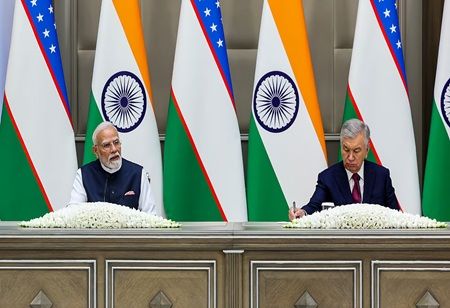
India and Uzbekistan elevate their bilateral relationship to a Comprehensive Strategic Partnership, while agreeing to establish a long-term arrangement for uranium supplies from Uzbekistan to India and setting an ambitious target of USD 5 billion in annual bilateral trade by 2030. The decisions follow talks between Prime Minister Narendra Modi and Uzbek President Shavkat Mirziyoyev in Tashkent on August 30.
The upgraded partnership reflects the expanding scope of cooperation between the two countries across strategic and economic sectors. The two sides sign 11 agreements covering trade, investment, infrastructure, critical minerals, mining, defence, pharmaceuticals, healthcare, information technology, education and digital public infrastructure.
Also read: ISRO Targets September 4 for Hawkeye Satellite Launch
Civil nuclear cooperation emerges as a key new area, with both countries agreeing to establish a long-term framework for uranium supplies from Uzbekistan to India. During the delegation-level talks, Prime Minister Modi says the two sides will establish a long-term arrangement for uranium supply. India's Ministry of External Affairs later indicates that discussions on the arrangement are positive and that an agreement is expected shortly.
The trade target also marks a significant expansion in bilateral economic ambitions. Current trade between India and Uzbekistan exceeds USD 1 billion, and the new target aims to raise annual bilateral commerce to USD 5 billion by 2030. Both countries plan to address issues related to market access, banking, payment systems and connectivity to facilitate greater commercial engagement.
To strengthen institutional coordination, India and Uzbekistan agree to establish a Foreign Minister-level Coordination Council to guide bilateral cooperation. The existing Joint Commission is also elevated from the secretary level to the ministerial level, giving it a stronger role in advancing economic and strategic initiatives.
Defence and security cooperation receive renewed attention under the upgraded partnership. India and Uzbekistan plan to encourage direct linkages between their defence industries and explore co-development and co-production of military equipment. Both countries also reaffirm their commitment to combating terrorism, violent extremism, organised crime, illicit drug trafficking and cyber threats through stronger intelligence-sharing and law-enforcement cooperation.
Critical minerals and mining form another important component of the partnership. Both sides identify opportunities to expand cooperation in strategic resources, while Uzbekistan also seeks stronger engagement with India in energy, pharmaceuticals, agriculture, jewellery and other sectors. Sector-specific roadmaps are expected to help translate these priorities into concrete projects.
Digital connectivity and people-to-people links are also set to receive a boost. Uzbekistan plans to remove visa requirements for Indian citizens for stays of up to 30 days, supporting tourism and business travel. Indian visitors are also expected to gain access to UPI-enabled applications in Uzbekistan within a year, strengthening digital payment connectivity between the two countries.
The leaders also agree to organise a joint business summit involving companies from both countries. The initiative is expected to encourage greater private-sector engagement, investment and partnerships as India and Uzbekistan work towards the USD 5 billion trade target.
Several agreements signed during the visit cover culture, education, tourism and Ayurveda. The two sides also conclude a Letter of Intent for the restoration and conservation of the Buddhist sites of Fayaz Tepa and Kara Tepa in Uzbekistan, strengthening their cultural and civilisational ties.
Also read: How Smart Homes Are Becoming Critical Infrastructure in India
The elevation of relations comes as the two countries mark the 15th anniversary of their strategic partnership. Modi describes Uzbekistan as being at the heart of India's engagement with Central Asia, highlighting the country's importance to India's broader regional outreach.
The expanded partnership therefore creates a broader framework for cooperation spanning nuclear energy, trade, defence, critical minerals, digital payments, healthcare, education, tourism and connectivity. With a new institutional mechanism and concrete economic targets, India and Uzbekistan seek to translate their growing strategic relationship into deeper economic and regional cooperation.