
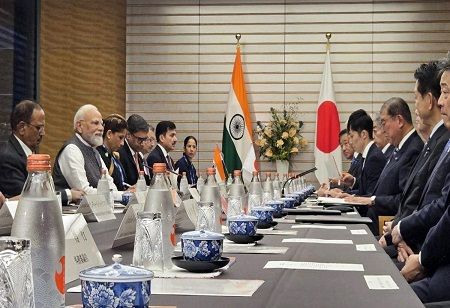
India, Japan Launch Manual for Low-Carbon Technology Cooperation
India and Japan launch an operational manual for their Joint Crediting Mechanism to promote low-carbon technologies, mobilise climate finance and facilitate technology cooperation under the Paris Agreement.
India and Japan have launched the Operational Manual for their Joint Crediting Mechanism (JCM), establishing a framework to promote advanced low-carbon technologies, mobilise climate finance and facilitate technology cooperation for emission reduction and removal projects in India.
The manual was jointly launched in New Delhi on September 30 by Japanese Ambassador to India Keiichi Ono and then Secretary of the Ministry of Environment, Forest and Climate Change Tanmay Kumar. The mechanism is intended to support sustainable development in India while strengthening transparency and confidence in international carbon markets.
Also Read: How India's Manufacturing Growth is Outpacing its Talent Supply
The launch marks an important step in operationalising bilateral cooperation between India and Japan under Article 6.2 of the Paris Agreement. The two countries signed the Memorandum of Cooperation (MoC) for the JCM on August 7, 2025, while the Rules of Implementation were adopted on June 8, 2026.
The operational manual establishes a detailed and transparent framework for implementing JCM activities. It covers the complete project cycle, beginning with the submission of a Project Idea Note and extending through project implementation, monitoring, issuance and authorisation of JCM credits.
Under the mechanism, India and Japan aim to encourage investment in projects involving advanced low-carbon technologies in India. The initiative is also designed to support technology transfer, capacity building and the development of domestic capabilities for deploying low-carbon equipment, systems and infrastructure at scale.
The JCM is expected to contribute to greenhouse gas emission reductions and removals while supporting sustainable development outcomes. It also provides a framework for the international trading of carbon credits generated through eligible projects under Article 6.2, subject to the agreed governance and authorisation procedures.
The Rules of Implementation adopted earlier this year established governance arrangements including a bilateral Joint Committee, project approval procedures, third-party validation and verification, sustainable development safeguards and national registries for tracking the issuance and transfer of credits.
Also Read: How Renewable Energy is emerging as India's Next Big Jobs Engine
The launch of the manual therefore moves the India-Japan JCM from institutional preparation toward implementation. By combining climate finance, technology cooperation and carbon-market mechanisms, the partnership is positioned to support wider deployment of low-carbon technologies and contribute to both countries’ climate objectives under the Paris Agreement.