India, Rwanda Agree to Expand Defence Partnership
Synopsis: India and Rwanda have agreed to expand defence cooperation in military training, joint exercises, defence industries, and medical collaboration, reinforcing their strategic partnership through the second Joint Defence Cooperation Committee meeting.
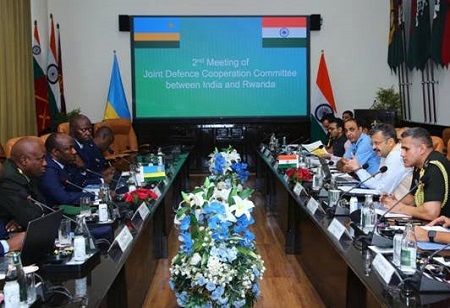
India and Rwanda have agreed to deepen their bilateral defence partnership following the second Joint Defence Cooperation Committee (JDCC) meeting held in New Delhi. The two-day meeting reaffirmed the commitment of both countries to strengthening military cooperation and expanding collaboration across key defence sectors, reflecting the growing strategic relationship between the two nations.
The meeting was co-chaired by Amitabh Prasad, Joint Secretary International Cooperation in India's Ministry of Defence, and Brigadier General Louis Kanobayire, representing the Rwanda Defence Force. Senior officials from both countries reviewed the progress achieved since the inaugural JDCC meeting and discussed measures to further enhance bilateral defence engagement.
During the discussions, both sides agreed to broaden cooperation in military training, joint military exercises, defence medical services, and the defence industry. The delegations also finalised an implementation plan with clearly defined timelines to ensure the effective execution of the initiatives agreed upon during the meeting. The roadmap is expected to accelerate practical cooperation and strengthen institutional coordination between the armed forces of both countries.
A major focus of the meeting was enhancing professional military exchanges. India and Rwanda agreed to expand training opportunities for defence personnel through specialised courses, capacity-building programmes, and knowledge-sharing initiatives. Increased participation in military education and professional exchanges is expected to improve operational capabilities and strengthen long-term defence cooperation.
Also read: Nestle India teams up with Genpact For Hyderabad GCC
The two countries also explored opportunities to strengthen collaboration in the defence industry. Discussions covered potential partnerships in defence manufacturing, technology sharing, and industrial cooperation, aligning with India's objective of promoting indigenous defence production while supporting the modernisation of Rwanda's defence capabilities. Expanding industrial collaboration is expected to create mutually beneficial opportunities for both nations.
Medical cooperation emerged as another important area of engagement. Both sides agreed to promote collaboration in military healthcare, medical training, and the exchange of expertise in defence medical services. The initiative aims to improve healthcare support for armed forces personnel while fostering stronger institutional links between military medical establishments.
The JDCC functions as the principal institutional mechanism for guiding defence cooperation between India and Rwanda. The current framework builds on the Memorandum of Understanding on Defence Cooperation signed during Prime Minister Narendra Modi's historic visit to Rwanda in July 2018. Since then, bilateral defence ties have steadily expanded through training programmes, high-level exchanges, and capacity-building initiatives.
Beyond defence, India and Rwanda maintain a growing partnership across trade, agriculture, healthcare, education, digital technology, and development cooperation. India has supported Rwanda through capacity-building programmes, concessional lines of credit, infrastructure projects, and technical assistance, reinforcing the broader strategic partnership between the two countries.
The successful conclusion of the second JDCC meeting reflects the shared commitment of India and Rwanda to building a stronger and more comprehensive defence relationship. By expanding cooperation in military training, joint exercises, defence industries, and medical collaboration, both countries aim to enhance regional security, strengthen institutional partnerships, and create new opportunities for long-term strategic engagement.