Vietnam and India Discuss Stronger Strategic Partnership
Vietnam and India have outlined a future roadmap for their Enhanced Comprehensive Strategic Partnership, focusing on trade, defence, digital technologies, connectivity, and emerging sectors while targeting US$25 billion in bilateral trade by 2030.
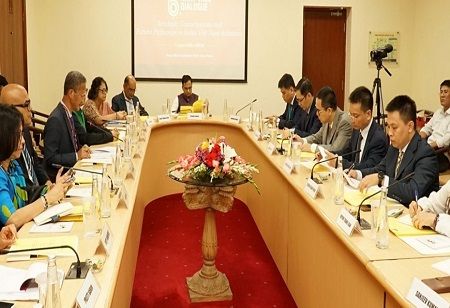
Vietnam and India have reiterated their intention to further strengthen their Enhanced Comprehensive Strategic Partnership through talks on how the two countries can achieve this in the future in terms of trade, connectivity, defense, technology, and regional cooperation. The deliberations were held at the 6th Dialogue between the Indian Council of World Affairs (ICWA) and Vietnam Academy of Social Sciences (VASS) in Hanoi.
On the matter of discussion, Anurag Srivastava, Director-General of the ICWA, observed that the relations between India and Vietnam have been raised to the status of an Enhanced Comprehensive Strategic Partnership due to the common vision of enhanced cooperation in the areas of strategy and economy. He added that this improved level of relationship is bringing new areas of cooperation in trade, defense, digital revolution, and people-to-people interactions.
Also read: India Opens Door for Return of Digital Payment Fees
Indian Ambassador to Vietnam, Sandeep Arya highlighted the efforts being made by India and Vietnam for increasing their bilateral trade volume to reach $25 billion by 2030. He added that the two nations were considering increased collaboration in areas like digital technology, artificial intelligence, semiconductors, cybersecurity, critical minerals and resilient supply chains which would form the basis of future bilateral economic growth.
The discussion also emphasized the significance of the security and defence cooperation, which remains one of the core pillars of the India-Vietnam relationship. It was noted that the cooperation between the two nations is expanding in the areas of maritime security, capacity building, defence training, and regional stability in the Indo-Pacific region. The two countries have reiterated their commitment to an open, inclusive and rules-based Indo-Pacific region.
In addition to strategic cooperation, emphasis was placed on fostering people-to-people relationship through increased cooperation in areas like education, health care, cultural exchanges, tourism, and academia. It was pointed out that increased institutional cooperation among universities, research institutions, and think tanks will enhance innovations, knowledge exchange, and sustainable development. The ICWA-VASS Dialogue was acknowledged as a significant forum for developing policy suggestions and mutual understanding among the two nations.
Also read: Why Global Companies are investing more in India's GCCs
Also, connectivity and ways of improving cooperation were discussed in light of the opportunities available through regional and multilateral organizations. India and Vietnam reiterated their resolve to cooperate in such platforms as the Association of South East Nations and the East Asia Summit among others in dealing with common issues as well as ensuring regional stability and economic integration. Collaboration in areas such as science, technology and renewable energy was emphasized in the dialogue.
These talks were in consonance with the increasing strategic convergences of the two nations as they continue to strengthen their political, economic, and technological ties with each other. With the help of a high-trade target as well as the increased cooperation in newer fields, India and Vietnam hope to make their relationship more future-focused.