India and Denmark Expand Ties in Offshore Wind, Green Hydrogen
India and Denmark explore expanded cooperation in offshore wind, green hydrogen and renewable energy integration, building on their three-decade partnership and India's growing clean energy capacity.
India and Denmark are exploring opportunities to expand their renewable energy partnership, with a focus on offshore wind power, green hydrogen and the integration of renewable electricity into power systems. The discussions took place, during Danish Minister for Business and Competitiveness Martin Lidegaard's visit to New Delhi for the Bharat Renewable Energy Summit and Expo (BRESE) 2026.
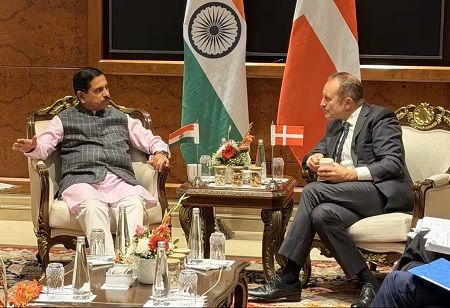
Lidegaard met Union Minister for New and Renewable Energy Pralhad Joshi to discuss ways to deepen bilateral cooperation and encourage greater participation by Danish companies in India's clean energy sector. The discussions covered offshore wind development, green hydrogen production and technologies to integrate renewable power into electricity networks.
Also Read: How India's Manufacturing Growth is Outpacing its Talent Supply
Both countries highlighted the complementary strengths of their energy sectors. India offers a large and expanding renewable energy market, while Denmark brings experience in wind power technology, energy efficiency, research and industrial innovation. The partnership aims to combine these capabilities to support clean energy deployment, strengthen energy security and improve the competitiveness of renewable technologies.
India has an installed wind energy capacity of nearly 60 gigawatts (GW) and is targeting 100 GW by 2030. The country recorded 6.05 GW of new wind installations in the financial year 2025-26. Its wind turbine manufacturing capacity has also expanded from approximately 10 GW in 2014 to 24 GW, creating opportunities for technology development and industrial collaboration.
During the discussions, Joshi highlighted India's broader progress in renewable energy. The country's non-fossil fuel-based installed electricity capacity has reached approximately 310 GW, compared with 200 GW in September 2024. He also noted that the renewable energy sector attracted more than $67 billion in investment over the past two years, including $6.2 billion in foreign direct investment.
Denmark's cooperation with India in the energy sector spans three decades, beginning with its support for establishing the National Institute of Wind Energy in Chennai. The two countries have since expanded collaboration through knowledge-sharing, technical assistance and institutional partnerships.
Lidegaard also opened Denmark's country session at BRESE 2026, titled A Green Transition through Sector Coupling. The session brought together representatives from government and industry to discuss integrating different energy systems, improving grid flexibility and using technology to accelerate the energy transition.
Also Read: Smart Buildings and IAQ Trends Shaping the Workplaces of Tomorrow
An International Energy Agency report on India's renewable energy market, co-funded by Denmark, was also launched during the event. It examines the policy developments, market trends, challenges and investment opportunities shaping India's renewable energy expansion.
The latest engagement builds on the India-Denmark Green Strategic Partnership and the renewed energy cooperation framework for 2025-2029. The partnership covers renewable energy integration, energy planning, technology exchange and capacity building, providing a foundation for further collaboration in clean energy development.