Government Approves $2.5 Billion CBG Support Scheme
The Union Cabinet has approved the ₹23,731 crore GOBARdhan Scheme to scale up compressed biogas production through assured pricing, capital support, and unified policy measures, boosting clean energy, rural incomes, and India's energy security.
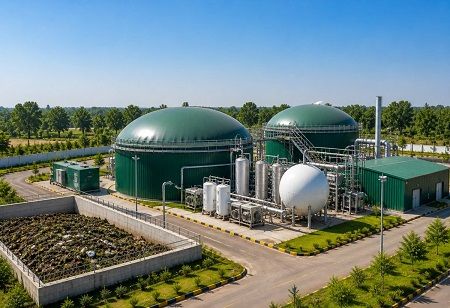
The Union Cabinet of India has cleared the GOBARdhan (Galvanizing Organic Bio-Agro Resources Dhan) National Integrated Plan for CBG (Compressed Biogas) with a total budget of ₹23,731 crores. GOBARdhan is an integrated scheme that intends to harness agricultural biomass residue, cow dung, municipal waste, press mud, and other types of biomass and convert it into energy while uplifting rural economies and ensuring better energy security in India. The plan will be implemented from fiscal year 2026-27 to fiscal year 2035-36.
The unified framework integrates several existing CBG-based schemes under the Ministry of Petroleum and Natural Gas (MoPNG) to build a streamlined ecosystem for the policy’s implementation and sectorial growth. The earlier schemes such as the SATAT scheme, MDA scheme, BAM scheme, DPI scheme, and CFA for CBG plants will function under a common umbrella for better coordination and growth of the industry.
Also read: Vietnam and India Discuss Stronger Strategic Partnership
This strategy outlines a system of support that aims at promoting investments in CBGs on a large scale. It includes guaranteed demand through procurement, reliable and profitable prices, and financial support in form of capital, assistance with connecting pipelines, credit guarantees, and technology development. All these elements are supposed to make the risk of investments smaller and the projects more viable.
One of the important aims of the GOBARdhan programme is to raise the domestic production of compressed biogas in India almost tenfold within the coming decade. It is anticipated that the programme will lead to considerable investment by the private sector and will create a thriving circular bio economy. Moreover, it will help India lower its dependency on imported natural gas since nearly 40 per cent of the natural gas needs of the nation are currently being fulfilled through imports.
It is anticipated that the integrated approach will help in generating employment opportunities along the entire chain of bioenergy production. Pipeline infrastructures and biomass aggregation machines would improve logistical efficiency and market access for CBG manufacturers and ensure that the biofuel reaches all parts of the nation.
Also read: Eco-Friendly Material Engineering to Replace Traditional Plastics
By incorporating several schemes into a single national program, the GOBARdhan project marks an important move in the direction of establishing a circular economy model based on the concept of waste to wealth. The scheme is in tune with the overall vision of India in terms of energy independence, reduction of carbon footprint, rural economic growth, and Atmanirbhar Bharat.